CantoBuddy - Cantonese with Jyutping, for Windows
CantoBuddy is our Cantonese product: the same always-on-top window and the same native-speaker recordings as our other apps, with a Jyutping line so you can read along before you can read the characters. The app interface is in English; the language inside it is Cantonese.
Learn while you work - in your spare moments
It makes full use of your spare moments, so you can learn while working on other things on your computer - in a small window that does not block your work interface, making every second of your time count.
Your spare moments, used well
Learning happens while you get on with your work. The app plays one line at a time on a timer you set, so five spare minutes still move you forward.
A small window that never gets in the way
It sits in a corner of the screen, or docks to the top edge as a slim bar. Your document, spreadsheet or browser stays fully usable.
Every second counts
Every line and every word comes with a native-speaker recording that travels with the app, so it works offline anywhere.
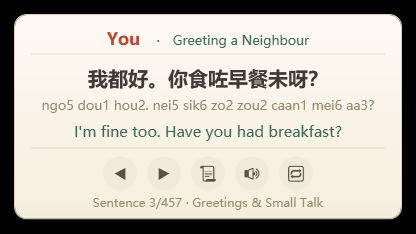
See the real interface
Two editions, one shared audio library — this is exactly what you get on your PC.

System requirements
| Operating system | Windows 10 or Windows 11 (64-bit) |
|---|---|
| Runtime | Microsoft .NET 10 Desktop Runtime (x64) for the website installer and ZIP builds; the Microsoft Store version needs nothing extra |
| Audio | Any Windows audio output device (headphones work well in an office) |
| Disk space | Both editions need under 400 MB together, plus the .NET Desktop Runtime if it is not installed yet |
| Offline | All 2,457 native-speaker recordings are stored inside the app - no account, no internet connection |
Why Cantonese needs its own app
Cantonese is spoken by tens of millions of people in Hong Kong, Macau, Guangzhou and Chinese communities worldwide, and it is not the same language as Mandarin - different words, different tones, and a romanisation of its own called Jyutping. Most courses treat it as an afterthought. CantoBuddy does not: the dialogue and word libraries are built for Cantonese, and every line is recorded by a native speaker.
The online word list is free
You do not need to install anything to start learning. The Cantonese word list on this site is free to browse, searchable in characters, Jyutping or English, and filterable by topic - and it comes in the same three language versions as the product itself.
One product, three languages
The word list pages on this site are published in English, Traditional Chinese and Simplified Chinese, each with its own address and language tags, so you can read them in whichever script you use - and search engines send each reader to the right version.
How to read Jyutping
Jyutping spells Cantonese with Latin letters plus a tone number at the end of every syllable. 你好 (hello) is nei5 hou2. The letters behave roughly as in English: j sounds like the y in yes, c like ts, z like ds. The number is the tone, from 1 (highest) to 6 (lowest) - and a few syllables such as m4 and ng5 have no vowel at all, which is why they look strange at first.
Where to get CantoBuddy
CantoBuddy is being prepared for release alongside our five other products. Write to myhama@hotmail.com and we will send you the current build, the licence details and the download link.
CantoBuddy questions
Is Cantonese the same as Mandarin?
No. They share a writing system, but they are different spoken languages with different vocabulary, different tones and their own romanisation (Jyutping for Cantonese). A Mandarin speaker cannot follow a Cantonese conversation without learning it.
Do I need to read Chinese characters?
No. Every line shows Jyutping and English as well, and you can hide the Jyutping line once you no longer need it.
Is there a free trial?
Yes - the same seven-day trial as our other products, and the same one-time price of $29.99 for a lifetime licence.
Is the audio computer-generated, or does an AI model produce it?
No. Every line was recorded by a native speaker before release and is shipped as an MP3 file that the app plays back. The apps contain no AI, speech or language model of any kind, nothing is generated while you use them, and no online service is called.
 ChineseBuddy
 FrenchBuddy
 SpanishBuddy
 ItalianBuddy
 GermanBuddy